I arrived in Mexico City a few nights ago and woke up the next morning in the MCC office guest rooms where I am still staying. Andrew, another SALTer in Mexico, and I are doing some in-country orientation for a few days before I take off to Chiapas to settle into my new life for the next year. I arrived in Mexico feeling supported and excited after spending a week in Akron, Pennsylvania at MCC’s Welcoming Place, or headquarters, for another orientation. That week was filled with information, reflection, and discussion, but what I’ll most likely remember besides my new friends is a basket of umbrellas. I’ll get to that, but let me back up for a second.
Mennonite Central Committee started as an idea in a basement Bible study in the early 1900s when a group of Mennonites in Elkhart, Indiana received correspondence that kindred Mennonites in Europe were starving. The group organized and delivered needed supplies, traversing miles and seas, to relieve a famine. Years later, after that project had become a memory and paperwork in storage files, the same Mennonites reinvented the “Mennonite Central Committee” with the goal of uniting Mennonites around the world with the common goal of providing assistance for all kinds of needs. That Bible study outreach project has since grown into a multinational organization that will celebrate its 100th birthday in 2020. Today, MCC works around the world in the areas of relief, development, and peacebuilding, serving people of all nations and faiths.
As time has passed, some things about MCC have changed. When J. Ron Byler, the executive director of MCC US talked to us about MCC’s history and work during orientation, he described MCC’s work today as being relationship rich and program poor. For example, my work with MCC will be to support a local organization in southern Mexico that works with migration. Instead of creating its own program in southern Mexico, MCC formed a local relationship and supports work already being done by people who are experts in the context because it’s their home. This relational thing seems to be big for MCC.
Here’s where the umbrellas come in. At the door of every building on the Welcoming Place campus is a basket filled with umbrellas. Next to each basket is a sign that says something like, ‘if you need an umbrella to get to another building, borrow one of these and leave it in the basket at the door of where you are going.’ It seemed to me such a simple way of encouraging people to trust each other. If I used one of those umbrellas, I felt responsible for not losing it or misplacing it because I knew that other people at the Welcoming Place might also need it. In the same way, I could trust that I didn’t need to bring an umbrella with me everywhere because the whole campus had a shared set. I thought that this simple umbrella-sharing system seemed to hint at something larger.
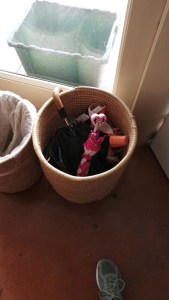
Living in community and building relationships requires one to take risks. I could have easily lost one of those umbrellas, and hypothetically MCC could one day be without any umbrellas at all if that continued to happen. However, the sense of community and trust that a shared umbrella system creates is clearly more valuable to MCC than the risk of needing to occasionally purchase new umbrellas when folks lose them. If MCC is willing to take a risk to build community, I wondered what I am willing to take risks for. I imagine that this year will be full of risks for me, and that is an idea that I am getting used to. However, I know that some risks are worth taking because the journey I will walk this year has been walked before. The first MCCers, who took a risk to feed their starving brethren, found confidence by reading stories in their Bible study of someone who took a risk centuries before to “bring good news to the poor… proclaim release to the captives and recovery of sight to the blind, to let the oppressed go free, [and] to proclaim the year of the Lord’s favor.” (Luke 4:18) Some risks are worth it. I can’t predict what this year will hold for me, but I hope that when given the chance to take a risk in order to see this “good news” I will take it.
 inactive