All eyes in Mexico are wide-open, waiting to see who will win. On one hand, the presidential election is taking place on July 1, and on the other, the Mexican national soccer team is playing in the World Cup. As I walk home from work these days, I see signs of the upcoming election – literally billboards, advertisements, songs, parades, and concerts from local and national candidates from every side of the aisle. I also see t-shirts doning the Mexican flag, televisions playing reruns of the most recent World Cup game, and the faces of the national soccer team athletes in the windows of seemingly every other business. After Mexico beat the reigning world champion German soccer team in their first game of the Cup this past Sunday, I’ve heard more optimistic comments about where Mexico is headed. However, I think everyone here is still holding their breath when it comes to the presidential election. Migrants especially are waiting to see what to expect.
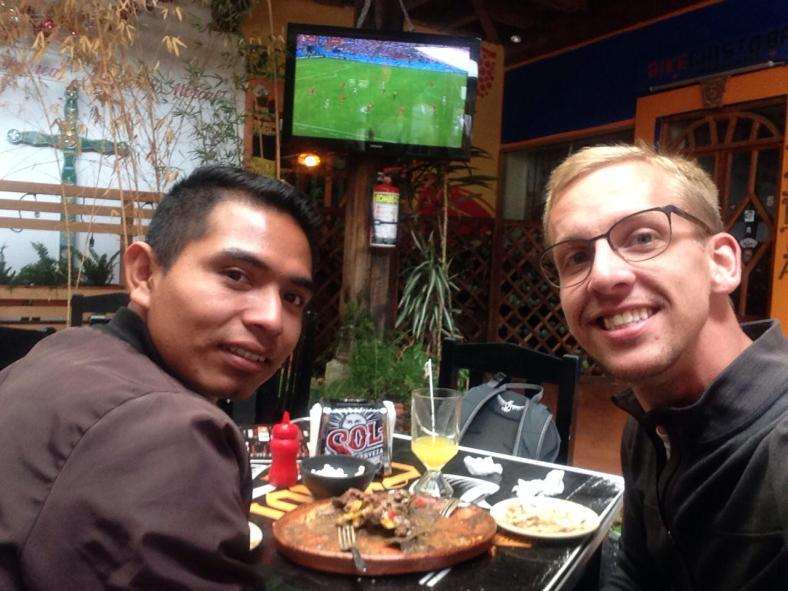
Manuel Gomez Hernandez, my colleague, and I watch the World Cup.
The presidential election in Mexico
Following the presidential election in Mexico at times feels like watching a telenovela. The three leading candidates seem to more often critique each other rather than propose their own solutions to issues, often creating quite the dramatic scene. All men, the candidates are running for a six-year term as president of the United States’ southern neighbor, with a one-term limit in office. Mexicans are widely suspicious of politicians, whom they see as highly corrupt and dishonest. Corruption has actually been a leading issue for voters and candidates in this election, if not explicitly, then at least in the the historical patterns that polls seem to show are changing. The PRI party ruled Mexico from 1930 until 2000 when Vicente Fox of the PAN party won, and another PAN candidate won the following election in 2006. Power returned to PRI with the election of current president Enrique Peña Nieto in 2012. Peña Nieto is widely unpopular throughout the whole country, so it seems to be no surprise that current PRI candidate is lagging in third place in the polls, perhaps indicating that Mexicans are looking for a change. However, if the three leading candidates have anything in common, it’s opposition to U.S. president Donald Trump and his policies and rhetoric towards Mexico. Mexican president Peña Nieto has mostly remained quiet and compliant in the era of Trump, only recently speaking out against a Trump move to send the National Guard to the U.S. southern border. While migration hasn’t played a large role in political debates among the Mexican candidates for president, it seems that the candidate with the most confrontational approach to Trump is leading the polls.

The “Mover a Chiapas” and Green Party hosted a rally and concert in the center of San Cristobal de las Casas last Saturday.
The favored candidate according to most polls has taken a nationalist and protectionist “Mexico First” approach that appears similar to the populist tactics of Donald Trump, but his politics are much different than those of the U.S. president. Andres Manuel Lopez Obrador, former Mexico City mayor and leader of the leftist Morena party, seems to be on his way to “Los Pinos,” and he has said that he will bring with him an end to corruption and crime. He is in favor of reworking the widely unpopular education reforms, and negotiating to maintain NAFTA, although he said that if he isn’t successful in this regard, Mexico would at least be able to focus more on its internal economy, specifically in rural areas. In terms of migration, he has proposed the idea of lowering taxes and increasing wages near the northern border to incentivize people to stay in Mexico. He has also mentioned creating programs to help integrate returned migrants from the United States. Like all other candidates, Lopez Obrador is against U.S. proposals to build a border wall between the two countries, and instead has proposed working with Trump to increase economic development in Mexico and in other Latin American countries. He has also talked about containing migration on Mexico’s southern border, although he has not specified what he means by this. Some analysts believe that even if Lopez Obrador wins the election, an uncooperative congress will make it hard for him to pass any legislation.

“Morena” party supporters march through the streets of San Cristobal de las Casas.
In a not-so-close second place in election polls is “Mexico In Front” candidate Ricardo Anaya. Some would call him a more conservative candidate, but recent analysis of Mexican politics have erased the ideas of “left” and “right” and more accurately describes politicians in Mexico as “opportunists” who present proposals on individual issues for specific groups of people rather than adhering to any kind of ideology. In fact, the political alliance that Anaya represents is formed by PAN, a widely-thought centrist party, and PRD, the leftist party which Lopez Obrador left in 2014 to form the Morena party that he currently represents. The blurring of these lines of politics actually reflects a reality in Mexico that is seen after almost every election: politicians jump between political parties based on which one has the most power. Some of Anaya’s political ideas might be seen as conservative, for example when he said in a recent debate that “the best social policy that exists is employment, well-paid employment.” However, he is also in favor of eliminating taxes on citizens that make less than $10,000 MXN per month, which is roughly $500 USD. In terms of immigration, he has been openly in favor of welcoming Central American migrants arriving at Mexico’s southern border, saying that doing so would give Mexico moral higher ground over the United States. He has also mentioned increasing funding for Mexican consulates in the United States to better serve Mexicans living aboard.
If it’s worth mentioning at all, polls are calling Jose Antonio Meade, candidate for the ruling PRI party, the third-place guy. His unpopularity is probably more indicative of the unpopularity of current PRIista president Peña Nieto than Meade’s own politics. With most eyes looking toward Lopez Obrador, Meade seems to blur into the background. In a recent debate, he expressed his favor for equipping hospitals with necessary supplies, improving the wage gap between men and women, and increasing high school graduation rates among young people. He hasn’t quite offered any specific strategies on any of these issues, which mirrors his suggestions on migration-related topics. In one debate, he mentioned wanting local-level authorities to create programs to keep Mexicans at home instead of migrating.

In the days before the presidential election in Mexico, political rallies and advertisements are a common sight throughout the country.
July is yet to come
I will be in Mexico City during the quarter finals of the World Cup and the presidential election, in the capital city and center of it all. A colleague shared with me the other day that he believes the coinciding of these two big events is a strategy. He thinks people will be so distracted by the World Cup that they won’t vote, and that the corruption that has plagued Mexican politics will continue, as if it were all planned this way. His skepticism reminded me of what Octavio Paz wrote in his book about Mexican life and culture, The Labyrinth of Solitude. Paz writes that, “modern man likes to pretend that his thinking is wide-awake. But this wide-awake thinking has led us into the maze of a nightmare in which the torture chambers are endlessly repeated in the mirrors of reason.” The more we analyze reality and “open our eyes,” the more pessimistic we become. Perhaps it’s true that there is often no hope after reading the news. But, what if we hope for a world that is to come rather than what we already have? What if we close our eyes and put our trust somewhere else rather than in politics and bureaucracy?
Paz continues: “When we emerge, perhaps we will realize that we have been dreaming with our eyes open, and that the dreams of reason are intolerable. And then, perhaps, we will begin to dream once more with our eyes closed.”
 inactive