A Prayer for Eldest Adulthood: We are Christ’s Body

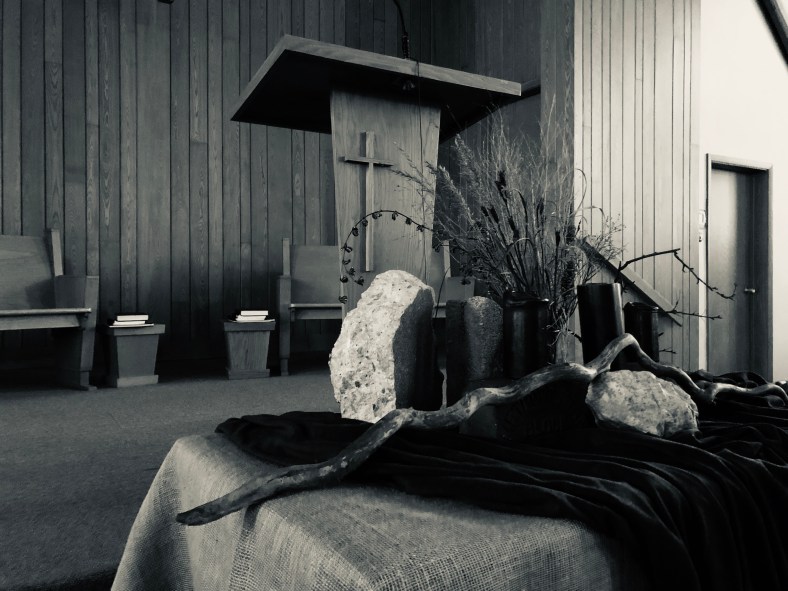
IMG_1046

a prayer, written by Ellen Morey

L-rd G-d,
we invite you here to be in this place with us.
Be the center of our circle.
All thanks and praise be to you,
Who are the Knower of hearts.
Where we bring concerns,
bring us peaceful, calm minds
in all wisdom.
Where we are processing,
let us nurture one another in kindness,
guiding each other toward you.
L-rd, hear our prayer.
(Free prayers for one another)

Bring a fresh wind to our passions!
Give us loving hearts.
Let us sense where you are moving
so we can let go of excess.
Make us like gentle water,
flowing to the lowest place
In order to bring balance.
L-rd, hear our prayer.
(Free prayers for loved ones and neighbors)

Restore our spirits in joyful dance
so our strength to do your will
in all self-control would not grow weary
As we patiently grow in faith,
rooted and grounded in Christ.
L-rd, hear our prayer.
(Free prayers for enemies)

You created the expanse of the universe
and the bonds between molecules.
You are closer to us than our own breath,
closer than our own souls.
L-rd, hear our prayer
(Free prayer for yourself)

Jesus, our Healer,
Protect our whole selves
so that we might love you more each day.
We pray all this in your precious name,

Amen.

–Ellen Morey

There it was! The Beersheba broom tree

Photo and reflection contributed by J. Nelson Kraybill

Beersheba broom tree ©2020 J. Nelson Kraybill (PSMC)

Several years ago I drove to Beersheba, southern-most city of biblical Israel. I remembered that after Elijah’s confrontation with prophets of Baal (1 Kings 18), Queen Jezebel vowed to kill him. Exhausted and spiritually spent, Elijah fled a day’s journey into the desert south of Beersheba. He lay down under a solitary broom tree, and wanted to die. He slept, but was awakened by an angel who said, “Get up and eat.” In front of Elijah was bread baked on hot stones and a jar of water. With that physical and spiritual nourishment Elijah walked forty days to Mt. Horeb (Sinai) to meet God.

So after visiting Beersheba, I drove “a day’s journey” (about fifteen miles) south looking for Elijah’s broom tree. There it was! Of course, not the same tree. But that became my holy tree, where I recalled times in my life when I was spent, discouraged, or afraid. In such low moments I too have received the bread of angels.

J. Nelson Kraybill

This is a time to live

WhatsApp Image 2020-03-18 at 5.47.21 PM

Luke 13:1-5 (Common English Bible)

Some who were present on that occasion told Jesus about the Galileans whom Pilate had killed while they were offering sacrifices. He replied, “Do you think the suffering of these Galileans proves that they were more sinful than all the other Galileans? No, I tell you, but unless you change your hearts and lives, you will die just as they did. What about those eighteen people who were killed when the tower of Siloam fell on them? Do you think that they were more guilty of wrongdoing than everyone else who lives in Jerusalem? No, I tell you, but unless you change your hearts and lives, you will die just as they did.”

The crowds wanted answers for why bad things happen. We don’t know much about the two events that Luke includes here – Pilate’s execution of Gentiles and the fallen tower of Siloam – but the little we gather presents existential questions. Why would God-fearing Gentiles be killed after following the law? Why would innocent people die by random chance?  In these days of pandemic, we may be asking similar questions. At times like these, we may call God’s justice into question, or we may even try to justify God. “Perhaps those who suffer are facing the consequences of their own sins?” we may say alongside the crowds. Like them, we look to Jesus to affirm our simple answers. But Jesus resists. “Did these bad things happen because the people sinned?” Jesus simply says, “no.”

Instead of answering the question, “Why do we die?” Jesus asks, “Why do we live?” He redirects the crowds to their own humanity and calls on them to examine their lives. The kingdom of God is on Earth, and the crowds have the chance to live in its abundance – or surely face death. We modern readers know how the story continues: Jesus will die as well. Our God who came to us just as we are in flesh-and-bone also accepted our same finite humanity. Yes, like our God-On-Earth, we will also one day face our finitude. But here – and now – Jesus shows us that we have a chance to live.

  • Where have you seen the good in humanity during this pandemic?
  • What simple answers might Jesus be asking you to put aside during this time of big questions?
  • How is Jesus inviting you to live during this shared human experience? 

Jesus, you resist our simple answers. We ask that you would redirect our attention toward your Kingdom, that we may choose life over death. In the name of God-On-Earth-In-Flesh-And-Bone, amen.


Illustration: Martina Heiduczek

Hope in times of COVID-19

IMG_0560

Romans 8:18-25 (Common English Bible)

I believe that the present suffering is nothing compared to the coming glory that is going to be revealed to us. The whole creation waits breathless with anticipation for the revelation of God’s sons and daughters. Creation was subjected to frustration, no by its own choice – it was the choice of the one who subjected it – but in the hope that the creation itself will be set free from slavery to decay and brought into the glorious freedom of God’s children. We know that the whole creation is groaning together and suffering labor pains up until now. And it’s not only the creation. We ourselves who have the Spirit as the first crop of the harvest also groan inside as we wait to be adopted and for our bodies to be set free. We were saved in hope. If we see what we hope for, that isn’t hope. Who hopes for what they already see? But if we hope for what we don’t see, we wait for it with patience.

The Apostle Paul saw the world for what it is: a place of suffering and hope. Today as we live in a time of pandemic, we are aware of both of these realities as well. People in our community and world are concerned for their vulnerable loved ones, anxious about potential medical bills, and fearful of missing work because of quarantines. Paul writes, “the whole creation waits breathless with anticipation.” We are living with much uncertainty. Yet as followers of Jesus, we also live with hope. Places of gathering are taking precautions to protect our neighbors from a contagious disease, schools are finding creative ways to use technology to facilitate learning from a distance, and even our own congregation at Prairie Street is preparing to share the resources of our food bank with our neighbors. Paul writes that “we were saved in hope,” patiently waiting for what we don’t yet see. It is true that we do not yet see an end to the COVID-19 pandemic, but our hope moves us to action. The Spirit is at work in our responses to fear and anxiety as we choose love and concern for our neighbors. 

  • Where are you seeing the Spirit move during this time?
  • What groanings do you have as you wait on God?
  • How is God moving you in hope toward action?

God, our Creator and Healer, you give us hope. Show us where you are moving in our community and world to bring healing and restoration for all of creation, that we may rest assured in your salvation. Amen.

VIVA and other final words

image2

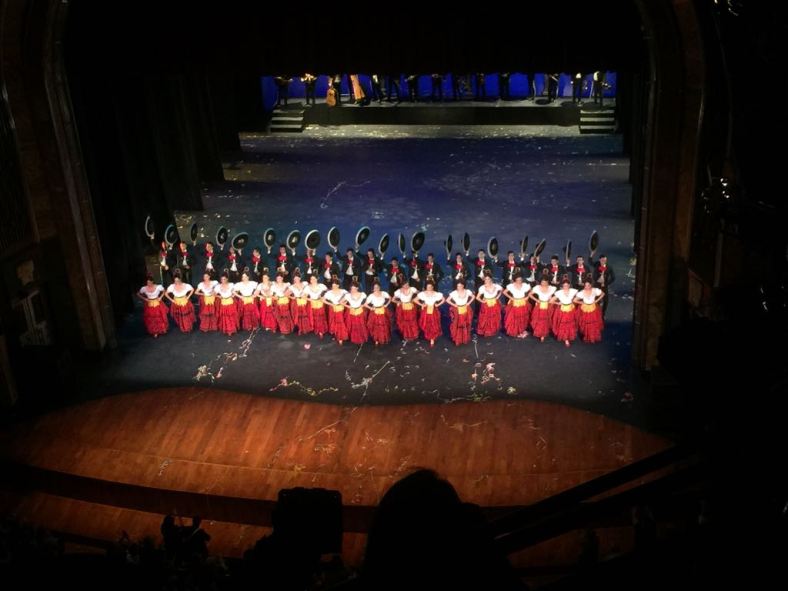
The stage curtain has closed on this act: living in Mexico. During one of my final evenings, I watched baile folklorico at Bellas Artes in downtown Mexico City – original Mexican art in arguably the most important cultural venue in the country. The choreography was warm and close, the costumes were colorful, the movement told a story. It represented everything I have learned this beautiful country to be. The performers lined up to bow at the end, and the audience stood up to applaud. I couldn’t stop smiling, but I didn’t want it to end. Then, the music began for an encore. This time the performers pulled people from the audience to join in the dancing, and the mariachis played a song that cued everyone to spontaneously yell !viva! in unison. The entertainment became a communal effort. When the bonus piece ended, the audience stood to applaud again, but it still wasn’t over. After four full encores, the curtain finally closed. Each additional piece seemed to say, “why do you have to leave already?” The lights came on, and I slowly stepped my way through the row of seats toward the exit thinking of an answer to that question.

image1

I have left already, back to the United States. My last few weeks in Mexico also felt like a series of encores. Those days were marked by many goodbye’s and despedida gatherings. One goodbye per person just isn’t enough in a place where relationships are the fabric of society. In a place where all efforts are communal and where relationships are not just a way of working, but a sense of identity, goodbye’s cannot just be a few, short words. In my final weeks, my friends and coworkers sent me off with words of blessing for my future and by sharing the ways they have learned with me over the past year. The extended goodbye’s invited me to think about all of the ways in which I’ve learned and grown, too.


In my rigidity, I’ve learned to let go of control and trust in people more than plans. In my black-white morality, I’ve learned to see the grey when the “best” resolution to conflict is not a realistic one. In my seriousness, I’ve learned that laughter is a tool for resilience and peacemaking. In my faith, I’ve learned to hope for truth-telling and reconciliation for a history of church violence against indigenous peoples. In my pride, I’ve learned to be humble and ask more questions than give answers.


“Why do you have to leave already?” The short answer is that in August, I’ll start working on an M.Div. at Anabaptist Mennonite Biblical Seminary in Elkhart, Indiana. The long answer isn’t as simple. It’s not easy leaving people that have taught me so much, and a place that has etched its own permanent piece of art in my memory. What is sure, though, is that I will bring all of the colors of Mexico with me in my mind and heart, even if I can’t be there every day. And Mexico, si Dios quiere nos volveremos a ver. God willing, we’ll see each other again.


(photos taken by Quinn Brenneke and Soleab Loun)

All Eyes on Mexican Election, World Cup

All eyes in Mexico are wide-open, waiting to see who will win. On one hand, the presidential election is taking place on July 1, and on the other, the Mexican national soccer team is playing in the World Cup. As I walk home from work these days, I see signs of the upcoming election – literally billboards, advertisements, songs, parades, and concerts from local and national candidates from every side of the aisle. I also see t-shirts doning the Mexican flag, televisions playing reruns of the most recent World Cup game, and the faces of the national soccer team athletes in the windows of seemingly every other business. After Mexico beat the reigning world champion German soccer team in their first game of the Cup this past Sunday, I’ve heard more optimistic comments about where Mexico is headed. However, I think everyone here is still holding their breath when it comes to the presidential election. Migrants especially are waiting to see what to expect.

WhatsApp Image 2018-06-19 at 4.24.44 PM.jpeg

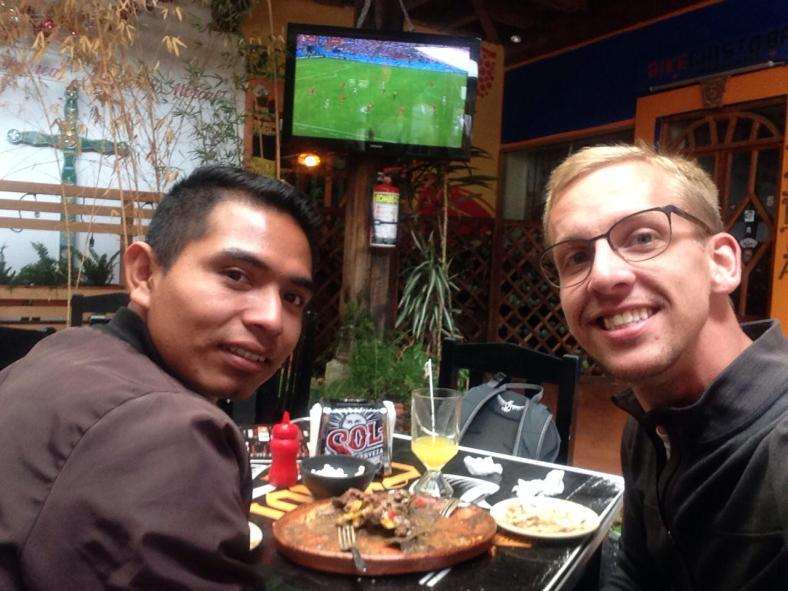
Manuel Gomez Hernandez, my colleague, and I watch the World Cup.

The presidential election in Mexico

Following the presidential election in Mexico at times feels like watching a telenovela. The three leading candidates seem to more often critique each other rather than propose their own solutions to issues, often creating quite the dramatic scene. All men, the candidates are running for a six-year term as president of the United States’ southern neighbor, with a one-term limit in office. Mexicans are widely suspicious of politicians, whom they see as highly corrupt and dishonest. Corruption has actually been a leading issue for voters and candidates in this election, if not explicitly, then at least in the the historical patterns that polls seem to show are changing. The PRI party ruled Mexico from 1930 until 2000 when Vicente Fox of the PAN party won, and another PAN candidate won the following election in 2006. Power returned to PRI with the election of current president Enrique Peña Nieto in 2012. Peña Nieto is widely unpopular throughout the whole country, so it seems to be no surprise that current PRI candidate is lagging in third place in the polls, perhaps indicating that Mexicans are looking for a change. However, if the three leading candidates have anything in common, it’s opposition to U.S. president Donald Trump and his policies and rhetoric towards Mexico. Mexican president Peña Nieto has mostly remained quiet and compliant in the era of Trump, only recently speaking out against a Trump move to send the National Guard to the U.S. southern border. While migration hasn’t played a large role in political debates among the Mexican candidates for president, it seems that the candidate with the most confrontational approach to Trump is leading the polls.

WhatsApp Image 2018-06-19 at 4.21.19 PM (1)

The “Mover a Chiapas” and Green Party hosted a rally and concert in the center of San Cristobal de las Casas last Saturday.

The favored candidate according to most polls has taken a nationalist and protectionist “Mexico First” approach that appears similar to the populist tactics of Donald Trump, but his politics are much different than those of the U.S. president. Andres Manuel Lopez Obrador, former Mexico City mayor and leader of the leftist Morena party, seems to be on his way to “Los Pinos,” and he has said that he will bring with him an end to corruption and crime. He is in favor of reworking the widely unpopular education reforms, and negotiating to maintain NAFTA, although he said that if he isn’t successful in this regard, Mexico would at least be able to focus more on its internal economy, specifically in rural areas. In terms of migration, he has proposed the idea of lowering taxes and increasing wages near the northern border to incentivize people to stay in Mexico. He has also mentioned creating programs to help integrate returned migrants from the United States. Like all other candidates, Lopez Obrador is against U.S. proposals to build a border wall between the two countries, and instead has proposed working with Trump to increase economic development in Mexico and in other Latin American countries. He has also talked about containing migration on Mexico’s southern border, although he has not specified what he means by this. Some analysts believe that even if Lopez Obrador wins the election, an uncooperative congress will make it hard for him to pass any legislation. 

WhatsApp Image 2018-06-19 at 4.21.18 PM

“Morena” party supporters march through the streets of San Cristobal de las Casas.

In a not-so-close second place in election polls is “Mexico In Front” candidate Ricardo Anaya. Some would call him a more conservative candidate, but recent analysis of Mexican politics have erased the ideas of “left” and “right” and more accurately describes politicians in Mexico as “opportunists” who present proposals on individual issues for specific groups of people rather than adhering to any kind of ideology. In fact, the political alliance that Anaya represents is formed by PAN, a widely-thought centrist party, and PRD, the leftist party which Lopez Obrador left in 2014 to form the Morena party that he currently represents. The blurring of these lines of politics actually reflects a reality in Mexico that is seen after almost every election: politicians jump between political parties based on which one has the most power. Some of Anaya’s political ideas might be seen as conservative, for example when he said in a recent debate that “the best social policy that exists is employment, well-paid employment.” However, he is also in favor of eliminating taxes on citizens that make less than $10,000 MXN per month, which is roughly $500 USD. In terms of immigration, he has been openly in favor of welcoming Central American migrants arriving at Mexico’s southern border, saying that doing so would give Mexico moral higher ground over the United States. He has also mentioned increasing funding for Mexican consulates in the United States to better serve Mexicans living aboard.

If it’s worth mentioning at all, polls are calling Jose Antonio Meade, candidate for the ruling PRI party, the third-place guy. His unpopularity is probably more indicative of the unpopularity of current PRIista president Peña Nieto than Meade’s own politics. With most eyes looking toward Lopez Obrador, Meade seems to blur into the background. In a recent debate, he expressed his favor for equipping hospitals with necessary supplies, improving the wage gap between men and women, and increasing high school graduation rates among young people. He hasn’t quite offered any specific strategies on any of these issues, which mirrors his suggestions on migration-related topics. In one debate, he mentioned wanting local-level authorities to create programs to keep Mexicans at home instead of migrating.

WhatsApp Image 2018-06-19 at 4.21.19 PM

In the days before the presidential election in Mexico, political rallies and advertisements are a common sight throughout the country.

July is yet to come

I will be in Mexico City during the quarter finals of the World Cup and the presidential election, in the capital city and center of it all. A colleague shared with me the other day that he believes the coinciding of these two big events is a strategy. He thinks people will be so distracted by the World Cup that they won’t vote, and that the corruption that has plagued Mexican politics will continue, as if it were all planned this way. His skepticism reminded me of what Octavio Paz wrote in his book about Mexican life and culture, The Labyrinth of Solitude. Paz writes that, “modern man likes to pretend that his thinking is wide-awake. But this wide-awake thinking has led us into the maze of a nightmare in which the torture chambers are endlessly repeated in the mirrors of reason.” The more we analyze reality and “open our eyes,” the more pessimistic we become. Perhaps it’s true that there is often no hope after reading the news. But, what if we hope for a world that is to come rather than what we already have? What if we close our eyes and put our trust somewhere else rather than in politics and bureaucracy?

Paz continues: “When we emerge, perhaps we will realize that we have been dreaming with our eyes open, and that the dreams of reason are intolerable. And then, perhaps, we will begin to dream once more with our eyes closed.”

Mexican history lesson a step to untangling a complicated context

The simple answer I often give to many of the questions I get about Mexico is “it’s complicated.” Politics are complicated, environmental devastation is complicated, culture is complicated, migration is complicated. In just two words, it’s a pretty truthful answer, but not very enlightening. To untangle the complications of the context I’m living in, the most helpful tool I have found is a history lesson.
WhatsApp Image 2018-04-16 at 12.39.37 PM

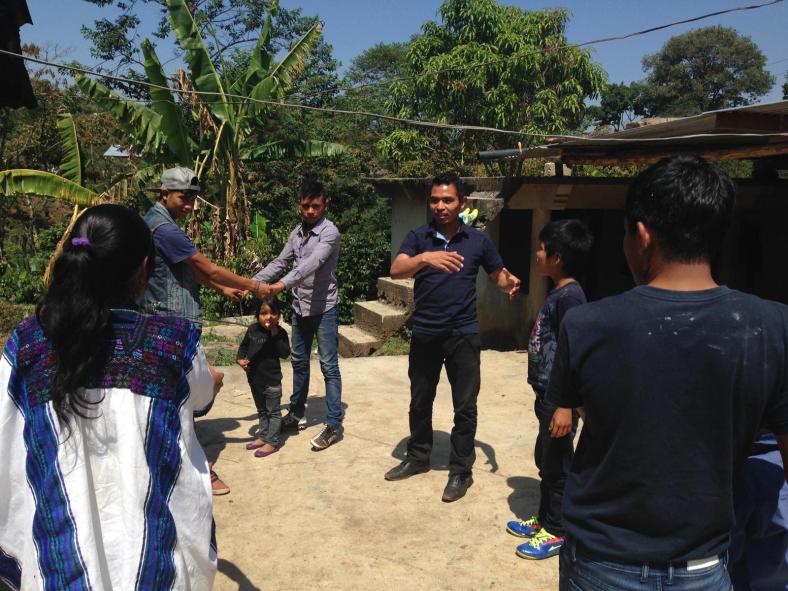
My colleague Manuel leads an activity in Chiloljá.

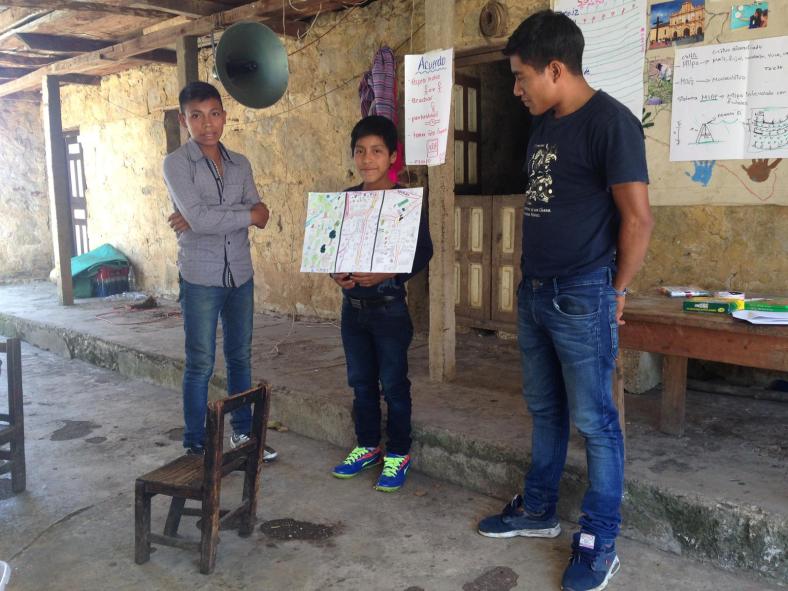
My colleague Manuel Gómez Hernández and I traveled to Chiloljá, a small indigenous town here in Chiapas, to facilitate a workshop with a community group a few weeks ago. Manuel asked the group in Tseltal, the local indigenous language, to draw a three-part picture of their community: what it used to look like, what it looks like now, and what they hope it will look like in the future.

WhatsApp Image 2018-04-16 at 12.39.10 PM

Participants in the workshop in Chiloljá created a three-part, timeline depiction of their community.

The participants in the workshop presented their artwork and discussed the changes they have seen in their community. Elders in the group shared their memories of a place where people upheld their culture, where everyone ate healthy food that they grew themselves, where the land was fruitful and natural resources were abundant. Younger people noted that although they have seen improvements since then like a school and a basketball court, the forest is disappearing, people buy cheap food and snacks from little corner stores, and many people leave the community to find work in northern Mexico or the United States. I sat with the group reflecting on their reality, wondering “how did we get to this?” It’s complicated.
WhatsApp Image 2018-04-16 at 12.39.17 PM

Young people from Chiloljá present their artwork.

If you have the same question, “how did we get to this?” and you want an answer longer than “it’s complicated,” here’s what I can give you. (History buffs, help me out here.)

Let’s backtrack a bit. The whole world was captivated with the idea of socialism after World War II ended, some with hope and others with anxiety. Some activists in Mexico were hopeful, leading protests and demonstrations. Many were looking for social reforms that were promised when the Mexican constitution was rewritten in 1917. As inequality in the country grew, these voices grew stronger. The United States and other political powers in the world were anxious. While the U.S. military engaged in the Cold War beginning in the 60s, trying to squash any hints of socialism around the world, Mexico entered its own internal Dirty War with a similar objective. During this time, the Mexican government widely used violence to quiet the unrest. Indigenous people in Mexico were among those speaking up for reforms and uniting their voices. The National Indigenous Congress, which nearly missed securing a candidate in this year’s presidential election, was formed in 1974. A more radical organizing of indigenous people came into formation in 1983 when the Zapatista National Liberation Army, or EZLN by its initials in Spanish, got its start here in Chiapas. (More on them in just a bit.) The sentiments of the revolutionaries of this period in Mexican history continued through the 1980s, but other actors began entering the scene at the same time.

IMG_2748

A timeline of events is on display in the Jtatik Samuel Ruiz museum in San Cristobal de las Casas, Chiapas.

The world had a lot of hope in the Mexican economy at the beginning of the 80s. Investors poured loans into the country, looking to exchange a small investment for big returns in the industrializing nation. Instead, Mexico began defaulting on the loans. With this, enthusiasm to invest in Mexico sharply dropped and so did the value of the Mexican peso. One U.S. dollar could buy 23 Mexican pesos in 1980, but just five years later, the same could buy 350 pesos. By 1993, the U.S. dollar was trading for 3,000 Mexican pesos. That’s when the Mexican government stepped in to try to save the currency from downward spiral by issuing new pesos. So as the coins in Mexicans’ pockets became more and more worthless throughout the 80s, is it any surprise that many of them began looking for other options for livelihood? The Mexican immigrant population in the United States nearly doubled between the 1980 and 1990. I’ll come back to this, but first, NAFTA.

This graphic that describes the Mexican immigrant population in the United States from 1980 to 2014 was borrowed from the Migration Policy Institute.

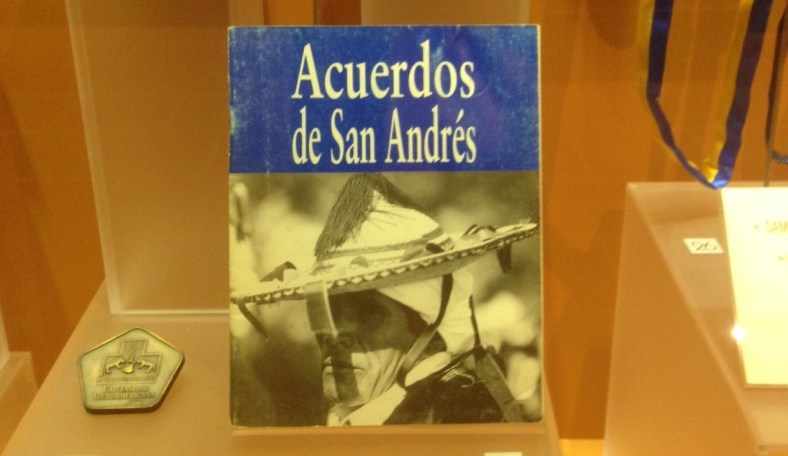
While the country was facing a harsh economic downturn, Mexico also was in the midst of negotiating a trade agreement with Canada and the United States. The North American Free Trade Agreement (NAFTA) was signed into effect on January 1, 1994, opening up tariff-free trade between the three countries. On the same day, the EZLN (the Zapatistas – I said I would come back to them) made their international debut by invading several cities in Chiapas by surprise, including my current home of San Cristobal de las Casas, to make it known that their interests should be considered in these policy decisions. They eventually entered into the San Andres Accords with the Mexican government, mediated by catholic priest Samuel Ruiz, to come to a peace agreement. (As it turns out, the Mexican government didn’t keep up their end of the bargain and conflict continued, which could be another blog post entirely.)
IMG_2749

A copy of the San Andres Accords are on display in the Jtatik Samuel Ruiz musuem in San Cristobal de las Casas, Chiapas. Samuel Ruiz was a widely-loved Catholic bishop among indigenous communities who mediated the accords between the Zapatistas and the Mexican government.

NAFTA had an immediate impact on Mexico, as the Zapatista uprising seemed to predict. The peso dropped in value again, calling for a $50 billion financial aid package from the U.S. government and the International Monetary Fund. In connection, the gross national income in Mexico dropped sharply in 1994 and didn’t recover until 2000, meaning that Mexicans were widely making less money after NAFTA than they were before. Poverty levels spiked, but they have since leveled off and remain close to what they were pre-NAFTA signing. Inequality indicators also remain about the same as they were in the early 90s. Although, Mexico’s GDP has grown since NAFTA was signed, signaling an overall economic growth, the number of Mexican migrants coming to the United States has also grown. (This phenomenon might be explained by recent research showing that country emigration rates actually tend to rise to a certain point as an economy develops.)

The Mexican immigrant population in the U.S. doubled again between 1990 and 2000 during the aftermath of the NAFTA signing. As poor Mexicans were looking for a way to survive the immediate economic turmoil, the “American Dream” caught their attention. A rise in unauthorized immigration caused politicians in the United States to take action. During the 90s, under the Clinton administration, the U.S. government started building border fences to deter migrantsHowever, if you pay attention to the numbers, the effort was fruitless. Migration from Mexico to the United States has nonetheless continued to grow since. The new barriers like walls and fences have only caused migrants to attempt more dangerous routes through places like the Sonoran Desert and migrant deaths and disappearances have increased. A recent RadioLab podcast series discusses this issue in depth. In response, organizations like Voces Mesoamericanas, the MCC partner I support, have begun projects using DNA databases to inform families of disappeared migrants if their missing loved ones were found deceased near the border.

image1 (12)

This heart hangs in my office at Voces Mesoamericanas. It was created by Junax K’otantik, a group of families who have missing migrant loved ones. Their name in Tseltal means “our heart united”.


In the middle of this complicated history are individuals, families, and communities whose lives are affected by decisions made by powerful government bureaucrats. People in Chiloljá have lived through the economic downturns caused by large international partnerships like NAFTA, and they have also witnessed those agreements spur the growth of big businesses that now sell products in the little stores that sprinkle their small community. They have seen their young people leave the community – some don’t come back, while some do and bring with them a new culture. It’s complicated, but some things are clear.

Diego López Aguilar, the community leader who organized the group in Chiloljá, has a dream. He hopes to improve his community by creating a sustainable food system that will keep his family healthy and also incentivize others to not make dangerous trips north. He is studying agriculture science at a local university and has organized his community to begin experimenting with new techniques. If history is any indication, hope is in the Mexican DNA. It certainly is in Diego’s.

WhatsApp Image 2018-04-16 at 12.39.54 PM

Diego López Aguilar, of Chiloljá, took Manuel and me to visit his land where he raises a cow and grows vegetables. He would like to make a livelihood with these projects.