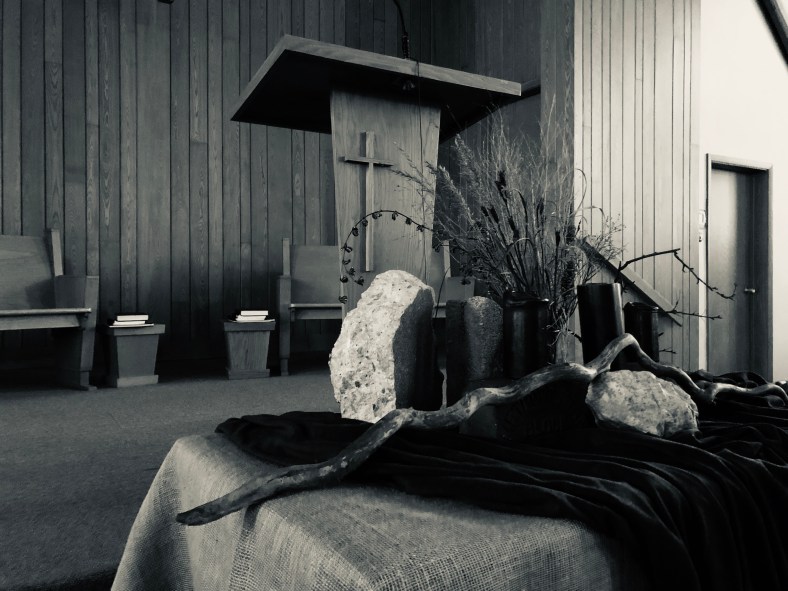
A Prayer for Eldest Adulthood: We are Christ’s Body

IMG_1046

a prayer, written by Ellen Morey

L-rd G-d,
we invite you here to be in this place with us.
Be the center of our circle.
All thanks and praise be to you,
Who are the Knower of hearts.
Where we bring concerns,
bring us peaceful, calm minds
in all wisdom.
Where we are processing,
let us nurture one another in kindness,
guiding each other toward you.
L-rd, hear our prayer.
(Free prayers for one another)

Bring a fresh wind to our passions!
Give us loving hearts.
Let us sense where you are moving
so we can let go of excess.
Make us like gentle water,
flowing to the lowest place
In order to bring balance.
L-rd, hear our prayer.
(Free prayers for loved ones and neighbors)

Restore our spirits in joyful dance
so our strength to do your will
in all self-control would not grow weary
As we patiently grow in faith,
rooted and grounded in Christ.
L-rd, hear our prayer.
(Free prayers for enemies)

You created the expanse of the universe
and the bonds between molecules.
You are closer to us than our own breath,
closer than our own souls.
L-rd, hear our prayer
(Free prayer for yourself)

Jesus, our Healer,
Protect our whole selves
so that we might love you more each day.
We pray all this in your precious name,

Amen.

–Ellen Morey

There it was! The Beersheba broom tree

Photo and reflection contributed by J. Nelson Kraybill

Beersheba broom tree ©2020 J. Nelson Kraybill (PSMC)

Several years ago I drove to Beersheba, southern-most city of biblical Israel. I remembered that after Elijah’s confrontation with prophets of Baal (1 Kings 18), Queen Jezebel vowed to kill him. Exhausted and spiritually spent, Elijah fled a day’s journey into the desert south of Beersheba. He lay down under a solitary broom tree, and wanted to die. He slept, but was awakened by an angel who said, “Get up and eat.” In front of Elijah was bread baked on hot stones and a jar of water. With that physical and spiritual nourishment Elijah walked forty days to Mt. Horeb (Sinai) to meet God.

So after visiting Beersheba, I drove “a day’s journey” (about fifteen miles) south looking for Elijah’s broom tree. There it was! Of course, not the same tree. But that became my holy tree, where I recalled times in my life when I was spent, discouraged, or afraid. In such low moments I too have received the bread of angels.

J. Nelson Kraybill

This is a time to live

WhatsApp Image 2020-03-18 at 5.47.21 PM

Luke 13:1-5 (Common English Bible)

Some who were present on that occasion told Jesus about the Galileans whom Pilate had killed while they were offering sacrifices. He replied, “Do you think the suffering of these Galileans proves that they were more sinful than all the other Galileans? No, I tell you, but unless you change your hearts and lives, you will die just as they did. What about those eighteen people who were killed when the tower of Siloam fell on them? Do you think that they were more guilty of wrongdoing than everyone else who lives in Jerusalem? No, I tell you, but unless you change your hearts and lives, you will die just as they did.”

The crowds wanted answers for why bad things happen. We don’t know much about the two events that Luke includes here – Pilate’s execution of Gentiles and the fallen tower of Siloam – but the little we gather presents existential questions. Why would God-fearing Gentiles be killed after following the law? Why would innocent people die by random chance?  In these days of pandemic, we may be asking similar questions. At times like these, we may call God’s justice into question, or we may even try to justify God. “Perhaps those who suffer are facing the consequences of their own sins?” we may say alongside the crowds. Like them, we look to Jesus to affirm our simple answers. But Jesus resists. “Did these bad things happen because the people sinned?” Jesus simply says, “no.”

Instead of answering the question, “Why do we die?” Jesus asks, “Why do we live?” He redirects the crowds to their own humanity and calls on them to examine their lives. The kingdom of God is on Earth, and the crowds have the chance to live in its abundance – or surely face death. We modern readers know how the story continues: Jesus will die as well. Our God who came to us just as we are in flesh-and-bone also accepted our same finite humanity. Yes, like our God-On-Earth, we will also one day face our finitude. But here – and now – Jesus shows us that we have a chance to live.

  • Where have you seen the good in humanity during this pandemic?
  • What simple answers might Jesus be asking you to put aside during this time of big questions?
  • How is Jesus inviting you to live during this shared human experience? 

Jesus, you resist our simple answers. We ask that you would redirect our attention toward your Kingdom, that we may choose life over death. In the name of God-On-Earth-In-Flesh-And-Bone, amen.


Illustration: Martina Heiduczek

Hope in times of COVID-19

IMG_0560

Romans 8:18-25 (Common English Bible)

I believe that the present suffering is nothing compared to the coming glory that is going to be revealed to us. The whole creation waits breathless with anticipation for the revelation of God’s sons and daughters. Creation was subjected to frustration, no by its own choice – it was the choice of the one who subjected it – but in the hope that the creation itself will be set free from slavery to decay and brought into the glorious freedom of God’s children. We know that the whole creation is groaning together and suffering labor pains up until now. And it’s not only the creation. We ourselves who have the Spirit as the first crop of the harvest also groan inside as we wait to be adopted and for our bodies to be set free. We were saved in hope. If we see what we hope for, that isn’t hope. Who hopes for what they already see? But if we hope for what we don’t see, we wait for it with patience.

The Apostle Paul saw the world for what it is: a place of suffering and hope. Today as we live in a time of pandemic, we are aware of both of these realities as well. People in our community and world are concerned for their vulnerable loved ones, anxious about potential medical bills, and fearful of missing work because of quarantines. Paul writes, “the whole creation waits breathless with anticipation.” We are living with much uncertainty. Yet as followers of Jesus, we also live with hope. Places of gathering are taking precautions to protect our neighbors from a contagious disease, schools are finding creative ways to use technology to facilitate learning from a distance, and even our own congregation at Prairie Street is preparing to share the resources of our food bank with our neighbors. Paul writes that “we were saved in hope,” patiently waiting for what we don’t yet see. It is true that we do not yet see an end to the COVID-19 pandemic, but our hope moves us to action. The Spirit is at work in our responses to fear and anxiety as we choose love and concern for our neighbors. 

  • Where are you seeing the Spirit move during this time?
  • What groanings do you have as you wait on God?
  • How is God moving you in hope toward action?

God, our Creator and Healer, you give us hope. Show us where you are moving in our community and world to bring healing and restoration for all of creation, that we may rest assured in your salvation. Amen.